And now, if you’ll indulge me, a word about cabernet. If there is hierarchy
among wines—and there is—Cabernet wears the crown. Here’s why.
The reasons for its monarchy are myriad, and as with kingdoms, not always
clear or universally accepted. But what is clear is that the Cabernet supremacy
is seldom disputed. So how did Cabernet achieve its eminence? For starters,
popularity. It continues to be, in spite of the trendiness of other grapes,
my favorite varietal. As it was for me, Cabernet is often the wine drinker's
initiation varietal. Its name recognition, availability and approachability
make it a secure jumping-off spot for the beginner. Cabernet's muscle reminds
you that you’re drinking something. Good Cabernet provides bold flavor and
straight-ahead definition that can be reassuring to an uncertain palate.
Mention Cabernet Sauvignon to any wine-drinking novice and you'll get a
nod of recognition. Say "primativo," you might get a blank stare.
From here, the drinker can begin to discern the subtleties that accompany
the countless other grapes of emerging popularity—even primativo.
This isn't to suggest that Cabernet lacks subtlety. On the contrary, it
possesses a kaleidoscope of character, ranging from big and tannic to smooth
and fruity. It can be lumbering and brutish or rangy and nimble. There are
as many Cabernet styles as there are taste buds. It all depends on who's
making it, which brings us to the next reason for Cabernet's preeminence:
versatility.
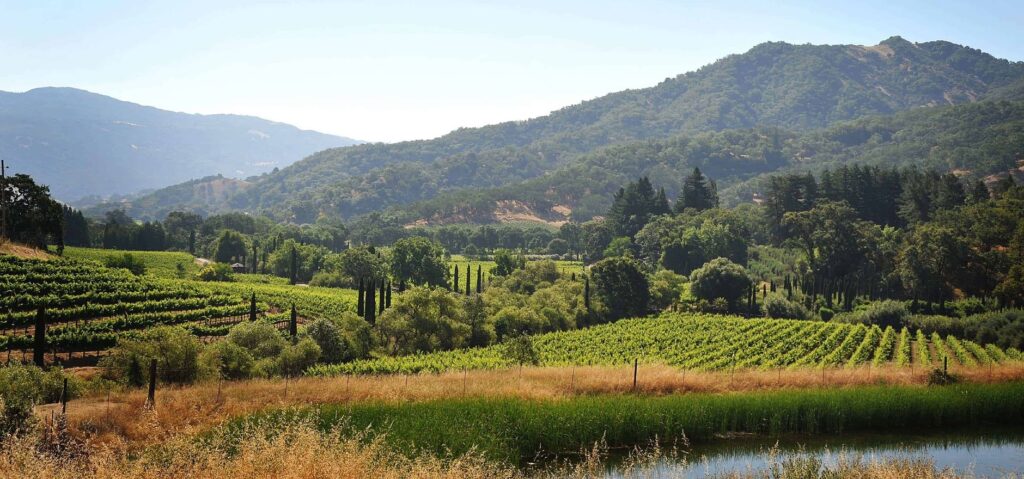
In the Napa Valley, Cabernet Sauvignon rules the roost. The climate is
so well suited to growing the grape that virtually every winery here either
produces a version of Cabernet Sauvignon currently, or has produced one
at some time in its history. The grapes bathe in the warm afternoon summer
sunshine. But just before they get too hot and shrivel, a bracing afternoon
breeze cools their jets. The result is fruit with remarkable balance and
structure; an ideal canvas for the adventurous winemaker—whose numbers are
strong in these parts.
The fruit gives itself to the winemaking shaper. The grapes can lend themselves
to phenomenal balance, no matter how big you're making it. It's not just
about high tannins. It's also about balance. Cabernet grapes can handle
more tannins and still remain balanced. They can also produce many complex
flavors.
Originating in the Medoc region of France, Cabernet was introduced in California
in the late 1880's. It has proven a durable fruit, adapting well to various
climates. But it does particularly well in the Napa Valley. This region
has been likened to Bordeaux, France, where for centuries red wines have
been created with Cabernet Sauvignon, Cabernet Franc and Merlot. These are
the same grapes is used in America' Cabs, which has become the default answer
to Bordeaux. Cabernet of course is also grown the world over. Fine cabs
have come from the reaches of South America, Australia, and Lebanon. They
also come from as close as Oregon and Virginia.
But in Napa, the king reigns. Cabernet grapes interpret the Napa climate
very well, concentrating its flavor in small berries with thick skin. And
although winemakers interpret it in many variations, Cabernet is typically
a medium to full-bodied wine. It is densely colored and full with rich berry
flavors—often cherry, plum, black currant. Pure cabs tend to have larger
tannins. Traditionally aged in oak, the barrels often impart their presence
on the wine and Cabernets are typically the oakiest varietal. However, these
days winemakers are aging wines in stainless steel as often as wood.
Whatever the aging process, age is a friend to Cabernet. Its quality goes
up as it lies down. Especially with higher-end cabs, which tend to have
high fruit concentration—they age well because they will hold their fruit
longer. And while top-end cabs tend to be 100 percent fruit, Cabernet's
supremacy also comes from its ability to blend well with other grapes. Many
great cabs are mixed partially with Merlot, for instance, resulting in a
softer, subtler wines but wines that do not surrender their quintessential
cabernet character.
There are many widely available full cabernets from the Napa Valley. But
more recently when people talk about 100-percent cabs they are talking about
the phenomenon of cult wines—extremely high-end wines, hand-crafted in small
lots, often in a facility no more glamorous than the winemaker's garage.
The wines sell for astronomical prices and are coveted, auctioned, and gossiped
about around the globe. Bearing names like Harlan, Screaming Eagle, Bryant
Family Vineyard, Colgin Cellars and Grace Family Vineyard, cult wines have
taken cabernet making to gorgeous extremes. As testament to the power and
ascendancy of the varietal, these wines are almost always cabs. Thankfully,
Cabernet fans needn't feel compelled to sell the house to buy a bottle or
wait ten years to open one. Napa Valley wineries have been creating impressive
cabernets and selling them at reasonable prices for decades—many immediately
drinkable.
My recommendation? Drink it now.