This week, in honor of the annual Dry Creek Valley Passport Weekend, I
thought a few words in praise of the venerable DCV were in order.
Mind you, unless you’ve already got your Passport, you cannot attend (there
is a “short list” upon which a lucky few reside, awaiting cancellations,
but nobody in their right mind cancels their Passport Weekend plans). No,
the event sold out, as it does every year, long ago and at a rapid clip.
The weekend event is one of the most anticipated events of the year in valley.
In spite of the seeming rarity of a passport pass (just 4,200 tickets are
issued), hundreds of people make this weekend their unofficial
kick off to the summer months in Wine Country. It’s fitting that
Dry Creek Valley, one of the unsung heroes of California appellations, makes
the first splash. Wine produced in the region enjoy a cult-like fanbase,
who love to sit about sipping and debating the finer points of
why their favorite bottle best typifies the winemaking climate and the very
valley itself—indeed California winemaking.
With nearly 60 wineries and 150
growers in the valley, the debate can stretch long into the evening.
Though I count myself among those with a horse in this race, I
pale in comparison to some I know, who jealously defend their favorite Dry
Creek varietal when anyone makes a challenge for another appellation’s supremacy.
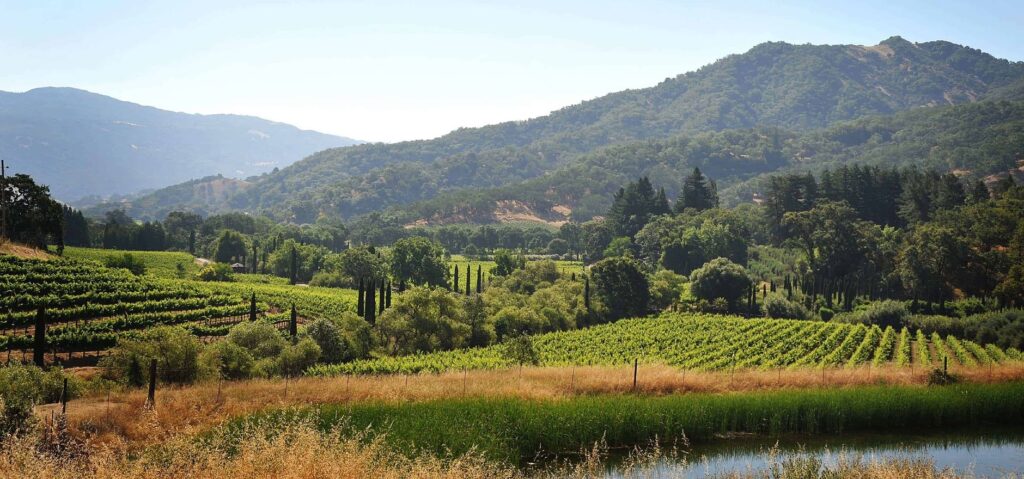
The happy reality is, there is plenty to love about Dry Creek Valley. Positioned
in northern Sonoma County, where the mornings enjoy cool ocean
air and misty fog, and summer days are long and full of intense
sunshine, Dry Creek is a naturally excellent agricultural opportunity. While
locally produced fruit also has a rabid following — if you’ve been to the
Healdsburg Farmer’s Market, at North and Vine streets, you understand what
I’m talking about – the fruit that grabs the headlines around here is grapes.
Especially zinfandel. Mention Dry Creek in most wine circles and the next
word uttered is usually zinfandel. The terrior is ideally suited for producing
zin, a grape that needs concentration to accurately express itself. Dry
Creek Valley soil, shallow with lots of stone beneath, is perfect for producing
concentrated fruit. The zins tend to be highly concentrated, beautifully
structured and zippy, with plenty of spice and a lengthy finish. Wonderful
examples of this — which also happen to be a few of my personal favorites
— can be found at Pezzi King (241 Center St., Healdsburg; 707-473-4310;
www.pezziking.com), Seghesio (14730 Grove St., Healdsburg; 707-433-3579;
www.seghesio.com), and Quivira (4900West Dry Creek Rd.; 800-292-8339; www.quivirawine.com),
where the zins are large and in charge.
Though the zinfandels are
the topic of discussion during passport weekend, the cabernet and
sauvignon blanc are also on the docket. These varietals, too, take
on Dry Creek characteristics—fruit-forward, full-bodied, and versatile.
The wines are easy drinking and refined, much like the valley itself and
those who love it.
While Passport isn’t the only time to take advantage of
the Valley and all it has to offer, it is one of the best times.
The wineries of Dry Creek celebrate their special place, many welcoming
guests with special themes (past events have featured a “Disco”
winery and “Summer of Love” tasting room). In addition to tastings and
interaction with winemakers, guests are treated to live music,
food, and other special surprises. It’s an excellent opportunity
to get to know Dry Creek Valley up close and personal.
So, assuming
you’ve got your passport, you’re in for a treat. But you don’t
have your ticket, my advice is get your now for 2008 and start checking
of the days on your calendar until next April.
Click Here to view previous
articles by Robert Farmer