|
Winter / Spring 2006
A River Runs Through It
The Napa River Brings to the Region Everything from Flora to
Fish to Fond Memories
By
Tori Ritchie
One June morning, I was strolling along the Napa River at the
edge of our property in Rutherford when a flash of orange caught
my eye. I figured it must be a candy wrapper that had floated
downstream. Putting down my mug of tea, I brushed back the reeds
and, to my surprise, found a small pumpkin. I followed its vine
and gradually uncovered an entire network of tiny squashes threading
through our garden.
By October, we had a full-blown pumpkin patch—riotous bursts
of amber, yellow, orange, and gold among the green grass and
trees. To celebrate, I gathered my friends and their kids for
a pumpkin hunt, and they harvested dozens of potential jack-o’-lanterns.
The best part was that we hadn’t planted any of this; the seeds
had washed down to our property from somebody’s vegetable garden
when the river flooded the winter before.
Those pumpkins are just one of the many gifts the river has
given my family. Another is the contour of our land. Over the
ages, the water has sculpted it into a soft, undulating knoll.
Our house sits at the crest of the knoll, and the river is essentially
our front yard. Along its banks, willows, bay laurels, and gracious
oaks bend to the water as if giving it thanks. There is a rocky
little beach where our dogs love to swim, fetching sticks and
cooling off. If we see the stately white egret that occasionally
wades by, we hold them back.
For me, the Napa River is the authentic heart of the valley,
linking history, geography, agriculture, and people as it flows
through life here. Even if I am not within sight of it, or can’t
hear its gentle rumble, I know it is always there.
That’s not to say we haven’t had trouble with the river. It
has notoriously jumped its banks and caused damage throughout
the valley, most recently in 1986, 1995, and 1997. But a network
of concerned citizens, government agencies, and regional groups
is working hard on restoration, and the river is growing healthier.
One of those concerned people is John Williams, owner of Frog’s
Leap Winery. He likes to point out what he calls “the whole historical
ecology of the place.” The river may be important to the agriculture
of the valley now, but for the Wappo Indians who lived here generations
ago, it was vital. They fished it for the salmon and steelhead
that used to run abundantly; they harvested acorns from clusters
of ancient oaks along its banks; and they shared the water with
the animals and birds who drank here, including bobcats, coyotes,
black-tailed deer, owls, and scrubjays. Williams tells me there
was a large Wappo settlement near the intersection of Mee Lane
and Galleron Lane, upstream from our house, and I’m beginning
to understand why I once found an arrowhead at the water’s edge.
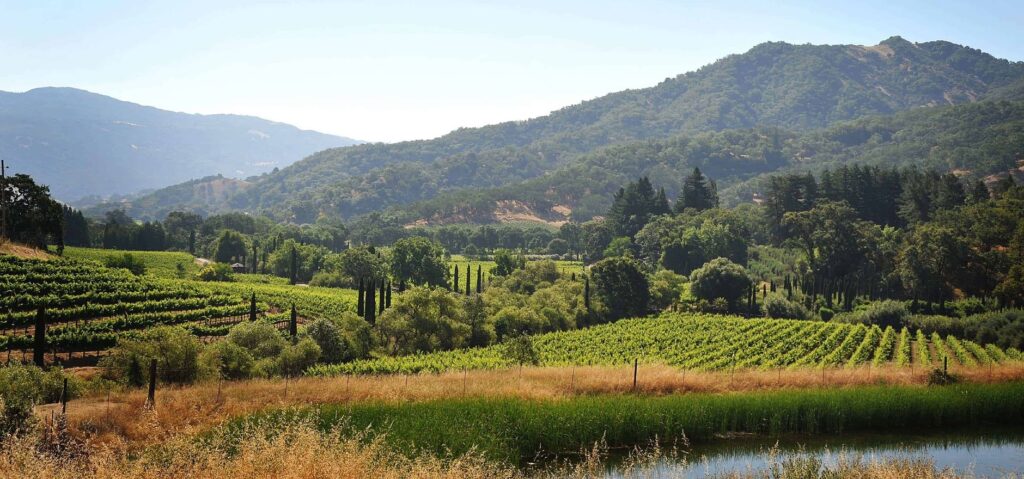
What about the river’s effect on vines? Williams credits the
many tributaries draining into it, particularly those in the
Rutherford appellation, for creating “gravelly alluvial fans
that are ideal for growing grapes.” He also points out that while
“the soils right along the river are a bit too vigorous for Cabernet
Sauvignon, they’re wonderful for Sauvignon Blanc.”
Getting close to the river, if only to sip Sauvignon Blanc,
is to feel the lifeblood of the Napa Valley. My favorite place
is the historic stone bridge on Zinfandel Lane near the Silverado
Trail. In winter and spring, the river thunders under the two
graceful arches of the bridge and over two sets of rocky falls.
I like to imagine the fish working their way up the rapids, heading
for their spawning grounds in the various creeks. I dream of
seeing one rise, its chrome siding flashing, as it follows an
instinct far older than man’s urge to grow grapes.
Another way to literally immerse myself in the river is to wade
in and fish it. I’ve cast a few lines on our property (with a
fish and game license clipped to my pocket, of course), but I’ve
never caught anything. Alex Ryan, general manager of Duckhorn
Vineyards, has, though. Not only did he snag a “big, fat” steelhead
in the waters by the winery, but growing up in the Napa Valley,
he fished near my house. “There used to be a giant hole there,”
he tells me. “We caught catfish by the bucketful. We’d spend
those classic children’s summer days, just catching fish and
worrying about nothing.”
More often during summer now, the river in the upper valley
tapers to a ribbon as the earth heats up, and the land, sky,
and water all seem to focus on the vines, concentrating their
energy to service the grapes. But downstream, starting at about
Trancas Avenue in Napa, it’s a different story.
There, the fresh waters of the upper stem start to mingle with
the salty tide seeping north from San Pablo Bay.
It’s an apt dividing line, where life on the river begins to broaden. There
are more fishermen on this end, angling year-round for striped bass, or “stripers,”
as they call them. It’s also more navigable for small boats, kayaks, and canoes.
“Paddling along, you’ll see fathers and sons, even three generations of people
fishing out there,” says Brian Streeter, chef at Cakebread Cellars, who often
kayaks the stretch south of Trancas. In downtown Napa, there are parks along
the banks, river trails for walkers and skaters, even a free symphony concert
over Labor Day weekend.
It’s also in downtown Napa that the river boasts its most productive
history. In the 1800s, there was an industrious wharf with passenger
ferries and cargo ships taking orchard fruits to market and returning
with supplies. To connect with that history, I go for lunch at
Angèle restaurant near Fifth and Main streets. It looks over
a lazy bend in the river where an occasional mallard duck paddles.
Next to the restaurant’s patio, a historic marker notes that
a schooner first docked near this site in 1844—five years before
the Gold Rush. This “Embarcadero de Napa” served as a terminal
for passengers and freight well into the 20th century, the marker
reads, and I’m reminded of a photo I’ve seen in the Napa Valley
Museum: a sepia-tone image of the steamship Zinfandel at
the Napa docks circa 1890. I suspect some of that freight included
robust local wines.
Below the town of Napa, the river spreads out into marshes and
wetlands as it closes in on the bay. Sometimes when I am leaving
the valley, I’ll stop in at Cuttings Wharf in the Carneros region.
There, Francis Cutting, who grew fruit in a nearby orchard, established
a wharf in 1893. Paddle-wheeled steamboats carried his fruit
(and that of other orchards, for a fee) to market in San Francisco.
Operations ended in 1909, but the wharf is still a popular spot
for fishing, and I often see anglers on the dock, waiting quietly
for stripers, or even the occasional sturgeon, to tug on their
lines.
A sign stuck in the bank at the end of the Cuttings Wharf Road
reads simply “END.” I can smell the salt and hear the gulls laughing,
and I sense there’s more bay here than river. Still, if I put
my hand in, I would touch water that had bubbled out from the
headwaters on Mount St. Helena and meandered by my house, gathering
strength from tributaries along its way while nourishing trees,
vines, and wildlife, and carving out history as it always has
and always will. And, perhaps, delivering more pumpkin seeds. |