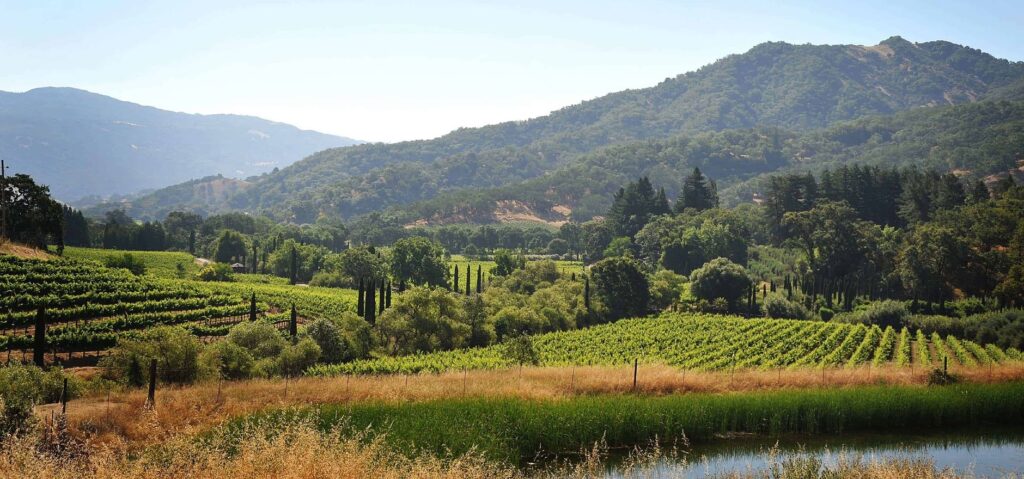

Vineyards are naturally beautiful. Whether blooming yellow with mustard
flowers or lush and ripe with grapes, the vines make for great
photo-ops. But what many people don’t realize is there is much to be seen
beneath the vines. Numerous wineries have a sort of buried treasure that
the casual observer never notices: caves.
The caves of wine country are
not the bat-filled variety. Instead they are filled with bottles
and barrels. There are dozens of great caves underground and in
hillsides throughout Wine Country. And more are being dug each year because
winemakers know that below ground is perfect environment for aging wine
– cool and with high humidity, like a never-ending late autumn day. Caves
are not new to winemaking – the practice dates to Ancient Rome – but for
many visitors to wine country, it’s a new way to explore the vineyards.
My
first cave experience was in Calistoga, when years ago I ventured
into the hillside at Schramsberg Vineyards (144 Schramsberg Road;
800-977-3623; www.schramsberg.com), the gracious sparkling wine
house situated up a mile-long driveway just south of the town of Calistoga.
I’ve seen dozens of caves since, but the caves of Schramsberg continue,
for my money, to be the standard bearer. Clocking in at some five miles
total, the warren of caves was originally hand dug in the late 1800s by
Chinese laborers. The walls—cool, moist, and layered with lichen—evoke a
sense of era-gone-by mystery. The cave tour is fascinating, divulging secrets
of the age-old methode champenoise—the traditional way to make Champagne
and sparkling wine. The methode includes the practice of ‘riddling,’ twisting
bottles a quarter turn each day as they lay on racks, which is done by hand
at Schramsberg to the tune of 35,000 bottle each day—by a single person!
There are some 5 million bottles underground at Schramsberg, dusty and content
and waiting patiently for the day their cork is popped and their contents
are exposed to the light of day.
Another favorite cave is not far from Schramsberg at
Clos Pegase (1060 Dunaweal Ln., Calistoga; 707-942-4981; www.clospegase.com),
where 20,000 square feet of tunnels were carved into the
rock at the center of the estate. Though the caves here do house aging
wine, the star attraction is the remarkable 350-seat Cave Theater,
used for private events and musical performances.
Dug by hand around the same time as Schramsberg were the caves
at Beringer (2000 Main St., 707-963-8989; www.beringer.com),
which 100 Chinese laborers carved with pick axes, shovels,
and six years of sweat. The 1,200 feet of tunnels are just part
of many historical attributes at this must-see winery.
The caves at Far
Niente (11350 Acacia Dr., Oakville; 707-944-2861; www.farniente.com)
were the first to be built in Napa’s modern era. Constructed
in 1980 when Gil Nickel bought the winery, the caves here are acknowledged
to have sparked the trend for building caves throughout the region.
The winery stores more than 2,500 barrels in the caves, which now
total more than 40,000 square feet and which is available to tour
by appointment.
Other caves worth exploring include Pine Ridge Winery (5901
Silverado Trail, 800-575-9777; www.pineridgewinery.com), which
are 100 feet below ground and house 4,500 barrels, and Rutherford
Hill Winery (200 Rutherford Hill Rd., Rutherford, 707-963-1871;
www.rutherfordhill.com), with a mile-long hillside system of tunnels that
contain 8,000 French and American oak barrels full of maturing varietals.