|
Summer / Fall 2006
Eat, Drink, Be Merry—and Be Healthy
The Sonoma Diet author Connie Guttersen shows how wine
country’s bounty is designed for good health
By
Kimberly Olson
Spicy Moroccan kebabs. Thick, crusty bread. A bottle of Cabernet.
And some great company with whom to share it. This is how Connie
Guttersen, R.D., Ph.D., wants you to eat. The Sonoma resident,
author of the hot new diet book The Sonoma Diet, says
the wine country lifestyle can help you gain health, feel great,
and even fit into your skinny jeans—all while enjoying food more
than ever.
In a country where fast food reigns and entire food groups,
from fats to carbohydrates, have become verboten, the idea of
sitting down to enjoy a sumptuous, flavorful meal with a nice
glass of wine is almost revolutionary. Except, perhaps, in wine
country, where every meal seems to be a celebration of life.
“Living here, you’re just immersed in great foods and a healthy
way of eating,” says Guttersen. “Wine country food is a touch
of Mediterranean, a touch of Latin, and a touch of Asian but
always focuses on wholesome, natural, fresh ingredients. At the
heart of the Sonoma Diet are 10 power foods that can help protect
against heart disease, diabetes, cancer, and even memory loss.”
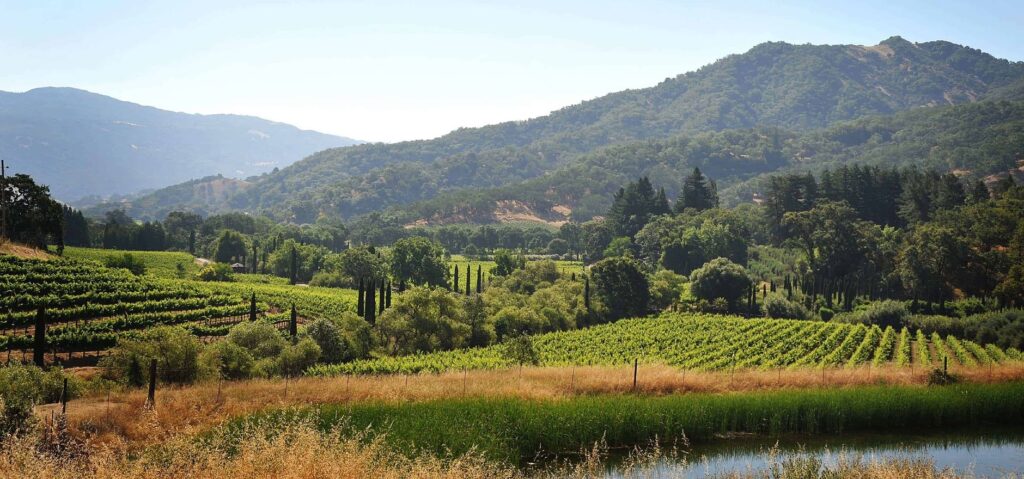
Thanks to their temperate climates, both Sonoma and Napa Counties
are brimming with superfoods—including Guttersen’s “power foods”—beginning
with sun-drenched fruits, vegetables, and nuts. In this food
category, Guttersen says, the heavy hitters are naturally sweet
strawberries, blueberries, and grapes, as well as tomatoes, spinach,
broccoli, bell peppers, and almonds—all flavorful, lowfat, and chock-full of
health-boosting nutrients. “The more colors on your plate—yellow, orange, red,
green, purple—the healthier,” Guttersen says. For the freshest, ripest fruits,
vegetables, and nuts, head to one of the region’s many farmers markets. Most
towns in Napa and Sonoma counties offer them, and the foods are all grown by
local farmers, who most likely picked their wares that very morning.
Another wine country staple is hearty, whole-grain bread and
pasta. “Whole grains are healthy, flavorful, and contain key
nutrients that are important for losing weight, like fiber,”
Guttersen says. One of her favorite bread makers is Della Fattoria
in Petaluma, which bakes up a host of tempting loaves like pane
integrale (whole wheat and pumpernickel) and seeded wheat
(with pumpkin, sunflower, sesame, and flax seeds).
To bring out the flavor of the grains, locals drizzle them with
another power food: extra virgin olive oil. Olives are so important
in Sonoma that every year, the county holds a special event called
the Blessing of the Olives, to kick off a celebration of the
fruit, the Sonoma Valley Olive Festival. Guttersen, who planted
Sevillano and Mission olive trees in her own backyard, says olive
oil can’t be beat for boosting heart health.
Find these oils—and perhaps engage in a tasting—at one of the
many artisanal olive oil producers in Northern California. (If
it’s the right season, you can even watch the pressing of the
olives.) One of Guttersen’s favorite producers is Petroni Vineyards,
which makes distinctive, Tuscan-style olive oils used by chefs
around the country. “Frantoio is the predominant variety of olives
we use here,” says Tim Crowe, Petroni’s general manager. “And
then there’s Leccino, Moraiolo, Pendolino, and Coratina.” The
result is an aromatic, buttery olive oil that’s a wonderful complement
to breads, salads, and pasta.
In addition to the power foods, Guttersen recommends rounding
out your meals with fish, lean meats, and flavorful cheeses,
which are all plentiful in wine country. As for foods that may
not be as healthy, allow yourself to indulge—a little. “Rather
than choosing a low-fat cheese, which may not taste as good,”
she says, “get a strong-flavored cheese, like blue or Gorgonzola,
and eat a little bit less.”
Of course, the perfect accompaniment to any wine country meal
is the elixir that gives the region its moniker. “A glass of
wine a day can help reduce the risk factors for heart disease,
diabetes, and Alzheimer’s,” Guttersen says. “It also gets you
to eat slower, taste your food, and savor it. So don’t be surprised
if you eat less and are more relaxed at the table.”
And that, after all, is really the key to wine country living. |