Come on, admit it: you're dying to know. Just how do professional sommeliers
identify the seemingly endless varieties of wine out there with just a quick
sniff and a little taste?
Allow me to enlighten you: it's not brain surgery.
People are constantly asking me how I can divine a Pinot from a Zin, tell
a Riesling from a Sauvignon Blanc and ID that soupçon of chicken coop in
my Chateauneuf du Pape. The answer is actually quite simple: practice! Just
as it does for riding a bike, practice makes perfect for honing your blind
tasting skills.
In fact, I’m quite sure that with a little practice lots more folks could
master the art of blind tasting. Sure, it takes some professional insight
and guidance at the get-go to make sure you’re doing everything correctly,
but once you’ve got that part squared away I think you’ll be surprised by
how decidedly un-mysterious tasting wine blindly can be.
The Basics
And so with no further ado I’d like nothing better than to clue
you in to the basics of blind tasting and get you on your way. Turns out
that just three things – seeing, smelling and tasting – are the activities
from which all wine tasting spring. But before we delve into them, let’s
take a quick moment to go over a few items that will help you get the
most from your tasting:
• Lighting: Make sure you’re in a well-lit room. Natural lighting is best.
• Surface: A clean and uncluttered white surface will enable you
to see the colors in the wine. Colored backgrounds distort the appearance
of the wine in your glass.
• Quantity: A two ounce pour is the ideal amount for tasting. In
the glass, this is roughly the height of the top half of your thumb between
the knuckle and tip.
• Materials: You may wish to have a pen and paper handy to jot
down notes on what you observe.
Appearance
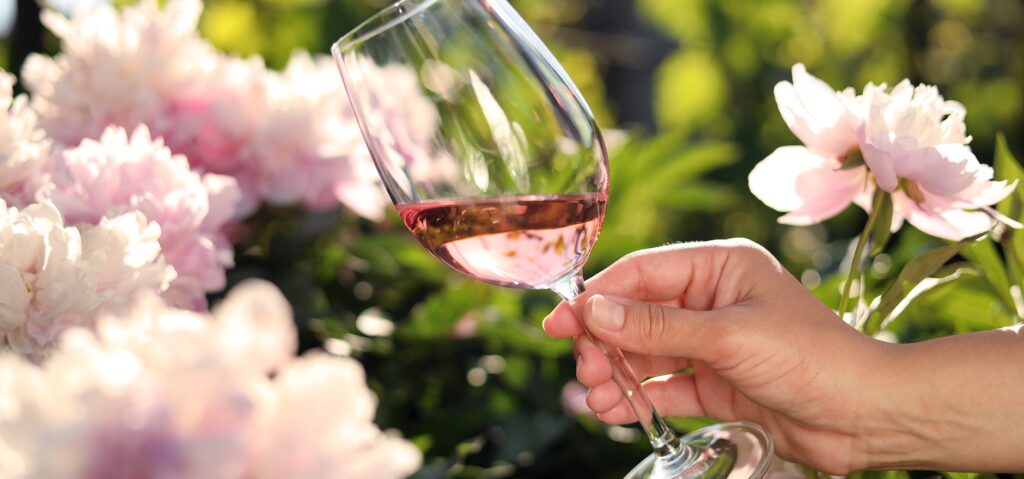
Wine comes in a gorgeous array of shades besides your everyday
red and white. In addition to these two common descriptors, wine may be
characterized as nearly translucent, straw-colored, green-yellow, golden,
amber, garnet, ruby, purple, inky black and, you guessed it, everything
in between. All of these subtle variations are clues to which grape variety
you’ve got in your glass.
Smell
Now, swirl the wine in the glass – this will stir up its aromas
and allow you to get a good whiff. Stick your nose in the glass and inhale
deeply. What do you smell? The human nose can detect as many as 10,000
different scents, and wine is chock full of interesting aromas. For example,
scents of vanilla and cream can often be attributed to oak used in the
wine’s maturation process, while fruit flavors such as berry fruits and
citrus fruits can be attributed to the grape variety (e.g. Pinot Noir
and Sauvignon Blanc, respectively).
I’ve included at the bottom of this article a list of common colors, aromas
and flavors associated some of the most popular grape varieties. When tasting,
use this list to try to match up scents and flavors in your glass with those
on the list. You’ll be surprised by how often you find a match!
Taste
Now, the good part. Take a sip of the wine and swish it around
in your mouth, pausing for a moment before swallowing. This will allow
the wine to coat all the surfaces of your mouth.
What do you taste? Some things to look for are fruit flavors (reds tend
to have red and black fruit flavors like cherry and blackberry, while whites
have citrus fruit flavors like lemon and tropical fruit flavors such as
banana). You might also taste stones, spice, coffee, leather, or herbs,
depending on what’s in your glass.
Again, cross reference what you’re tasting with the list of common flavors
found in wine below. If you were able to ID at least some of the flavors
noted for the variety you’re tasting then you’ve made some great progress
towards honing your blind tasting skills. Going forward, see if you can
taste those same flavors each time you sample a wine made from the same
grape variety. Over time, you’ll develop a familiarity with the variety
that’s the cornerstone of a blind taster’s skill set.
Quick note on balance
The best wines are what’s called “balanced,” meaning that their
building blocks, comprised of tannin (the component in red wines that
makes your teeth feel chalky), acidity, aromas, flavors and alcohol level
are in synch, with no one thing overwhelming the others. Does your wine
seem integrated and harmonious, or is it bitingly acidic or overly tannic?
Conclusions
Finally, take a minute to decide what you think about the wine.
Did you like it? Would you have it again? Did you think there were lots
of flavors and scents, or was it fairly one-dimensional? The most important
thing, after all, is what you like.
The more you taste wine, the more you’ll begin to notice these nuances.
Each time you try a new wine, spend a few minutes trying to identify its
key aromas and flavors. You’ll be surprised by how much you can pick up,
and by how decidedly un-mysterious tasting blindly can be. See you in the
tasting room!
Note: Courtney Cochran is a certified sommelier and wine consultant.